Nimona unfolds like a flower, growing from a lighthearted tale about an irrepressible girl with mysterious powers who worms her way into a gig as sidekick to her town's designated villain into something much richer and deeper. Noelle Stevenson's spritely line work gives the story even more lift, building a world where temp agencies handle evil-sidekick gigs and fantasy-armored bad guys plot to attack modern-looking city skylines with genetically modified dragons.
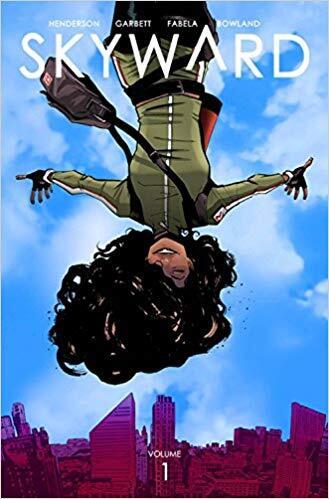
“G-Day” is the name given to the day that Earth suddenly lost a great deal of gravity. The generations born before G-Day were forced to adapt to an entirely new life, where flight is now possible and things (and people) have a tendency to float away. But for Willa Fowler, who was only a baby when G-Day happened, this “lighter” existence is all she’s ever known — and she’s pretty fond of the ability to jump up and soar. So when she accidentally discovers a potentially lethal plan having to do with gravity’s restoration, she knows something must be done to stop the baddies in their tracks.
Admit it — you're not exactly surprised to see this book turn up on this list. This is a comics list; we're NPR. We get it. But Art Spiegelman's two-volume feat of historical memoir wasn't simply grandfathered in. It received the many votes it did because it remains such a standalone accomplishment — a success in both conceit (Spiegelman's father haltingly relates how he survived a concentration camp, with Jews rendered as mice and Nazis rendered as cats) and craft (Spiegelman explores shades of survivor guilt, father-son frustration and the way the Holocaust forever reshaped the lives of those who made it through — and their children). A stunning work whose astounding success, including the first Pulitzer Prize awarded to a graphic novel, helped move the medium out of dingy comics shops and into the literary mainstream.
The book's subject — the way death retroactively imposes a shape on a person's life — belies the sense of hope that saturates every panel of this expressive and poignant story by Brazilian twin brothers Fabio Moon and Gabriel Ba. Chapter after chapter, we meet an obituary writer at different ages and follow him through some of the most important days of his life, and every one of those days — incongruously, magically — ends in his death. With each death, we read the obituary he would have written for himself, which does not come close to capturing the rich imagery, emotional nuance and lyrical language of the chapter we've just read. But that is the point: The merciless way death forces us to reduce lives to narrative arcs, to turn a person's existence into story beats and act breaks. Daytripper is the product of a clear-eyed perspective — the kind that only emerges once death isn't something feared, denied or raged against, but confronted. And embraced.
Comics about awkward young men struggling with adolescence are thick on the ground, which makes sense, given that the medium seems expressly suited to exploring the anxiety, self-consciousness and other ephemeral emotions that come with puberty. But relatively few comics have taken up the transition from girlhood to womanhood, and none have done so as sensitively and searchingly as This One Summer, written by Mariko Tamaki and illustrated by Jillian Tamaki. The story, about two girls whose families have been spending summers at the same lake for years, perfectly captures the moment when everything changes — when feelings, both expressed and unexpressed, begin to color and distort a childhood friendship, when long-simmering jealousy, fear and rage finally bubble over. It's nothing so pat and simple as a coming-of-age story; it's a beautifully wrought, bittersweet and achingly real examination of two young women — one who believes herself ready for adulthood, one longing to remain a child for just a little longer.
This is it, the comic book that launched a character and a craze and ultimately — among many other things — the state of our modern cinematic reality. Jerry Siegel and Joe Shuster's Superman leapt — literally — onto the scene in a patently ridiculous circus strongman outfit to save a wronged man from execution. Along the way, he beat up a wife abuser, rescued a tough girl reporter from a kidnapping attempt and secretly wooed that same reporter while wearing a clever (your mileage may vary on this point) disguise. Shuster's art wasn't big on detail — his eyes were slits, his mouth an em-dash — but it conveyed a tremendous sense of power and (thanks to the addition of a cape, snapping behind him as he jumped through the air) speed. Few remember the other characters who shared the pages of Action Comics #1 with Superman (Sticky-Mitt Stimson, anyone? Pep Morgan? Scoop Scanlon?), but he's still with us, in the ether, having pervaded the consciousness of the entire world. Yes, a couple less-than-stellar movies might have roughed him up a bit of it, but Superman can take it. He'll come back; he'll persevere. That's his whole shtick.